
Key characteristics of people and organizations thriving in the age of AI
Over the past two weeks, I've started to notice a few common characteristics among people and organizations that are beginning to thrive in the age of AI.
Kei Tsuda
6/12/20264 min read
I've had the privilege of meeting a remarkably diverse group of people: professionals at multinational companies in Tokyo, leaders driving global initiatives within major Japanese corporations, engineers shaping the future of Japan's manufacturing and infrastructure industries, executives and business leaders, educators who care deeply about the future of Japan's schools, as well as entrepreneurs, startup founders, and people exploring side businesses.
Japan's relatively compact geography certainly helps. Within just two weeks, I found myself meeting many of these individuals face-to-face.
If someone had told me two or three years ago that I would be crossing so many boundaries—between generations, nationalities, industries, and organization sizes—in such a short period of time, I probably wouldn't have believed them.
Today, however, this has become surprisingly natural.
We connect through LinkedIn, continue conversations online, attend events, and eventually meet in person.
What fascinated me most was that despite their vastly different backgrounds, many of them were wrestling with remarkably similar questions.
How will AI change the way we work, build our careers, and shape our organizations?
After dozens of conversations, I feel as though the outlines of an answer are beginning to emerge.
From what I've observed, three characteristics consistently stand out among people and organizations preparing themselves for the AI era.
1. They Combine Initiative, Expertise, and Curiosity
The first thing I noticed was that people's excitement—or anxiety—about AI had surprisingly little to do with their age or job title.
Instead, it depended on one simple question:
Are they actually using it?
Those who actively experiment with AI tend to spend less time worrying about whether it will replace them and more time asking,
"How can I use this?"
At the same time, they also recognize that simply using AI will not remain a competitive advantage for very long.
Eventually, the differentiator becomes something AI cannot develop on its own: human expertise.
For engineers, it may be confidence built through experimentation and technical knowledge.
For designers, it may be the ability to express taste, creativity, and empathy while collaborating with others.
For sales professionals, it may be the ability to deeply understand each individual customer.
The people who continue developing their expertise—and who see AI as an amplifier rather than a replacement—are the ones who seem best positioned for the future.
2. They Are Optimizing How They Choose and Use AI Tools
Another pattern has become increasingly visible.
Organizations are moving beyond asking,
"Should we adopt AI?"
Instead, they're asking much more practical questions.
Which tools should we use?
How many do we really need?
Who should have access?
Which workflows should AI become part of?
How do we measure success?
These conversations are becoming far more concrete.
What I also find fascinating is that generative AI and AI agents are beginning to redefine the value of software itself.
First we bought hardware. Then we bought software. Later, we subscribed to SaaS.
So what comes next?
Perhaps we are moving toward a future where we are no longer paying for access to software, but rather for the right to have AI teammates that understand our organization, participate in our workflows, and contribute meaningful work alongside us.
3. They Think About Governance and Incentives Together
Finally, there's the organizational dimension.
AI adoption cannot rely solely on individual initiative.
If everyone uses AI differently without coordination, organizations may gain pockets of efficiency—but not necessarily create greater organizational value.
One thing I heard repeatedly during candid discussions between companies was that their biggest challenges were rarely technical. They were organizational.
How much AI use is appropriate?
Who is accountable?
What happens when mistakes occur?
How do we develop people's skills?
How do we encourage experimentation while sustaining motivation?
Organizations that appear to be making the greatest progress aren't simply creating policies.
They're intentionally creating environments where people feel safe to experiment, learn, and improve.
Governance isn't there to restrict people.
It's there to make responsible experimentation possible.
Likewise, incentives shouldn't reward outcomes alone.
They should also recognize learning, curiosity, and the willingness to try something new.
Finding the right balance isn't easy.
But those organizations that learn to do it well—and do it early—may discover that governance itself becomes a competitive advantage.
Perhaps that's why many forward-thinking companies are introducing AI gradually, running pilot programs, learning from them, and continuously refining their approach rather than attempting large-scale transformations overnight.
People. Tools. Organizations.
What I've begun to see over these past two weeks is that organizations thriving in the AI era are not simply the ones with the newest AI technology.
They're the ones where people continue learning.
Where AI tools are selected to amplify human expertise rather than replace it.
Where organizational culture encourages thoughtful experimentation.
And where people are given the opportunity to grow alongside AI.
When those three elements—people, tools, and organizations—begin pointing in the same direction, AI stops feeling like a threat or an inconvenience.
It starts becoming something much more tangible:
A source of real possibility.
I'm still making sense of everything I've learned.
Many of these reflections emerged through conversations with speakers and participants at events such as MATLAB EXPO 2026 Japan hosted by MathWorks, Riding the AI Wave hosted by alliz, and "The Era When Personal Branding Drives Business" hosted by GRANDSLAM.
Each conversation revealed another small piece of a much larger picture.
So now I'd like to ask you:
What does the landscape look like where you are?
Is it still covered in fog?
Or are the outlines beginning to come into focus?
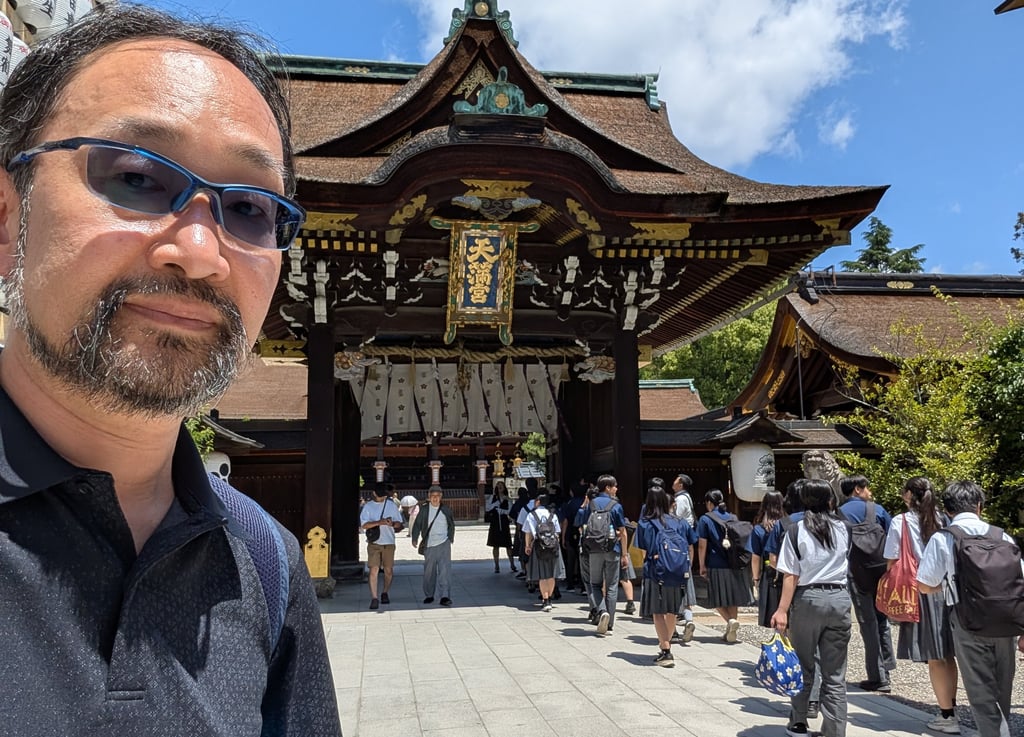
📷 The cover photo was taken at Kitano Tenmangū Shrine in Kyoto, dedicated to the deity of learning. Watching groups of students visiting on school trips reminded me that, even in the age of AI, it will ultimately be those who continue learning who shape the future.
AI is an incredibly powerful tool. But its true potential depends on the people using it—their initiative, their expertise, and their endless curiosity.
Contact & Inquiries
Feel free to reach out anytime. For first-time clients, sessions are offered for the deposit amount only ($5). This deposit will be fully credited toward your second session, so the first session is effectively free.
I would love to offer the first session completely free, but in the past, fully free bookings sometimes led to no-shows. To prevent that and to protect everyone’s time, I’ve chosen this approach.
© 2025. All rights reserved.